Platform
From pathology result to clinical action, without the avoidable delay.
The failure mode isn't unstructured pathology. It's clinical latency — the gap between a clinically significant result and the action it should trigger. Echo Pathways closes that gap with four governed steps, and shows its working at each one.
01 · connect
Retrieve context
A read-only FHIR connection pulls the relevant pathology and patient context from the system that already holds it. We don't ask the hospital to move its data.
02 · interpret
Structure the evidence
Reads FHIR, HL7 v2, PDF, image and free text. Normalises units, scales and censoring conventions; recognises amended and superseded reports — always preserving the link to the source.
03 · apply
Run the protocol
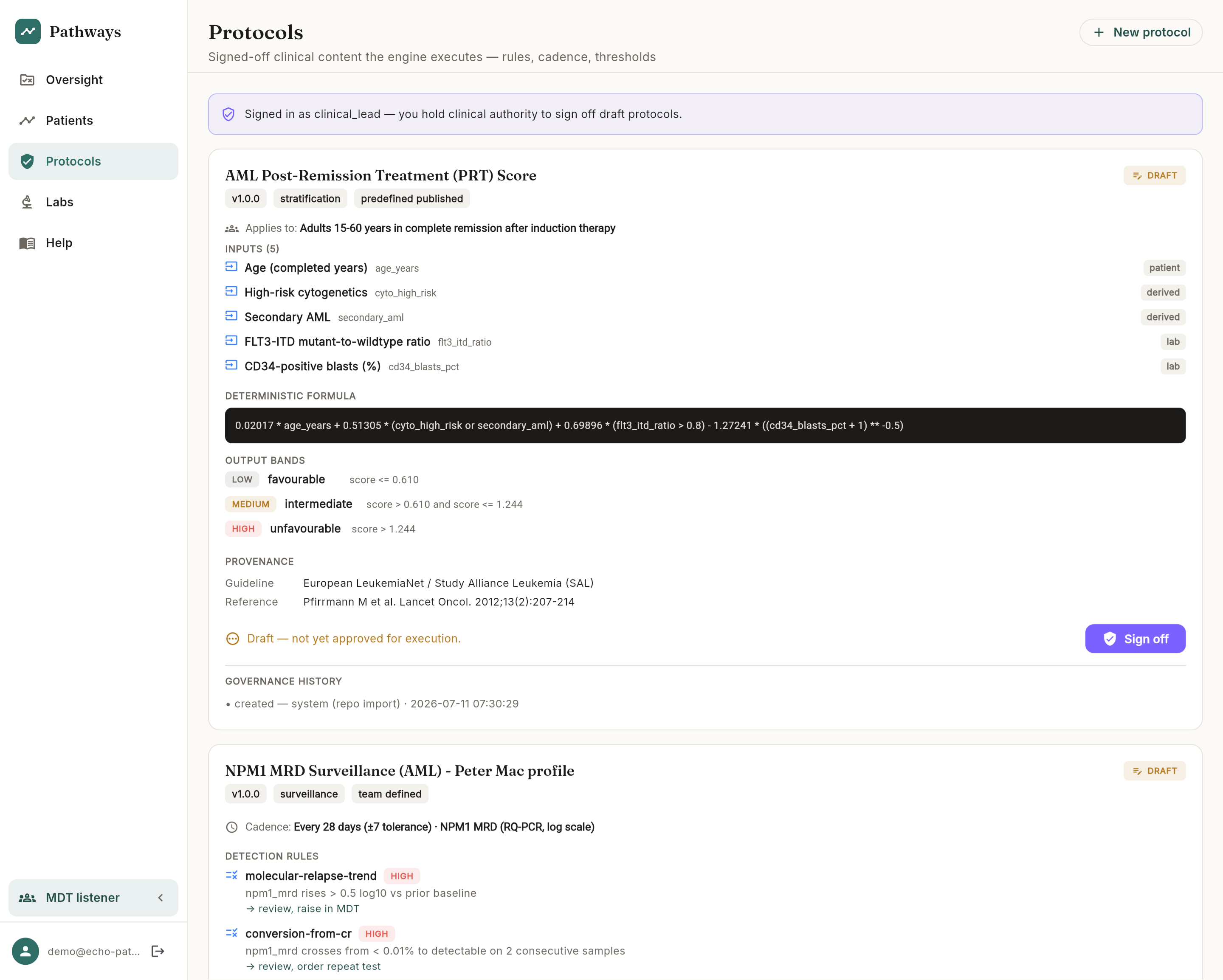
A deterministic rule engine evaluates the patient's active, signed-off protocol: trend detection, threshold crossings, and results that were expected but never arrived.
04 · alert
Alert & assign
A prioritised recommendation is assigned to the responsible clinician, with the source, the rule and the reason — and stays visible until a human reviews it.
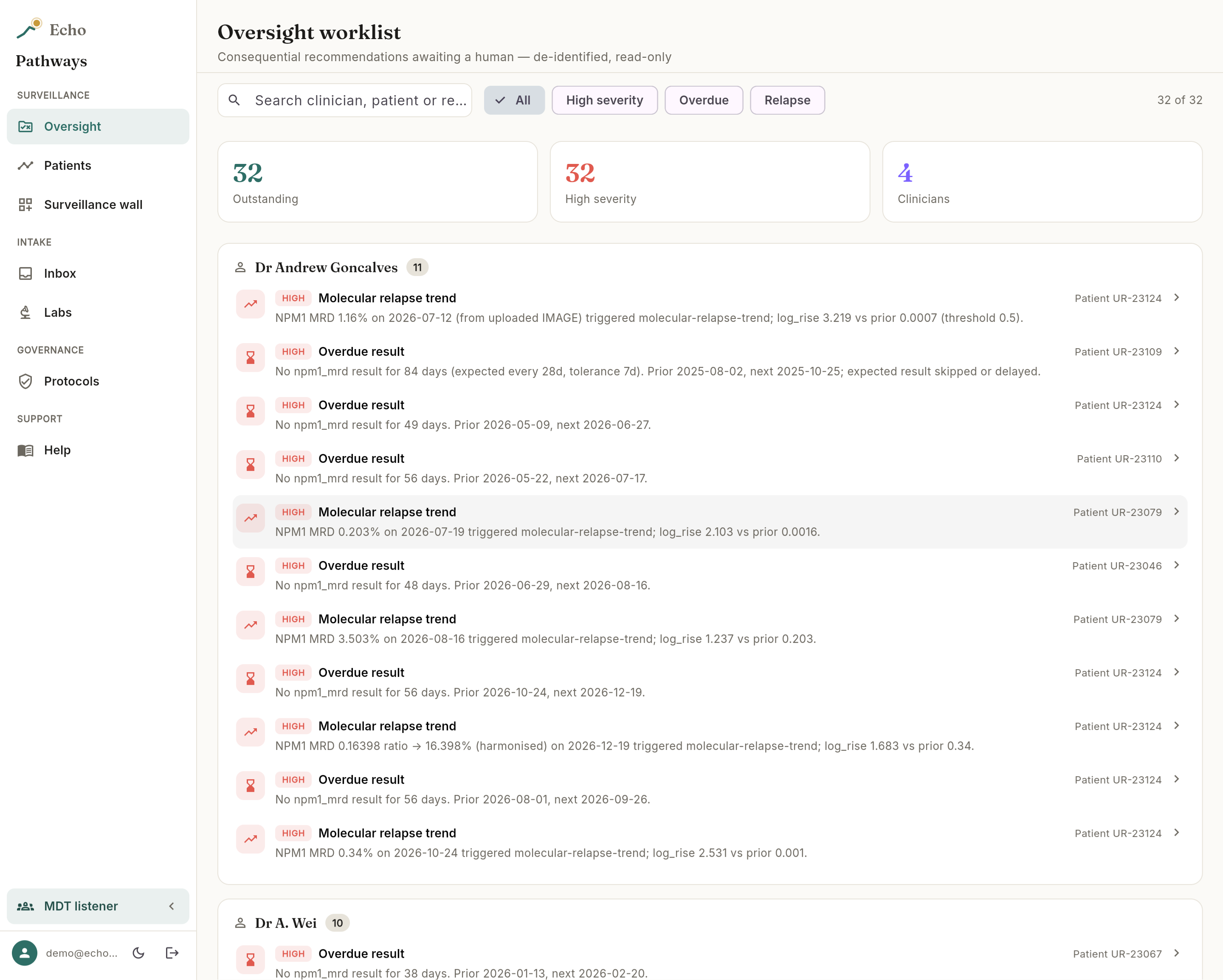
The oversight worklist
One screen: what needs a human, and who owns it.
The absence safety net
The result that never arrived is the one nobody is looking at.
Most surveillance tools react to data. The dangerous case is the opposite: a protocol expected a repeat marker in 12 weeks, and nothing came. There is no message to overlook, no row in an inbox, no alert to dismiss — only silence.
Echo Pathways tracks expected results as first-class objects and runs a clock against them. An overdue expected result is treated as high-severity, and escalates. This is the invariant we protect most carefully.
No npm1_mrd received for 84 days; protocol expects a repeat every 12 weeks (overdue-expected-result).
Evidence & provenance
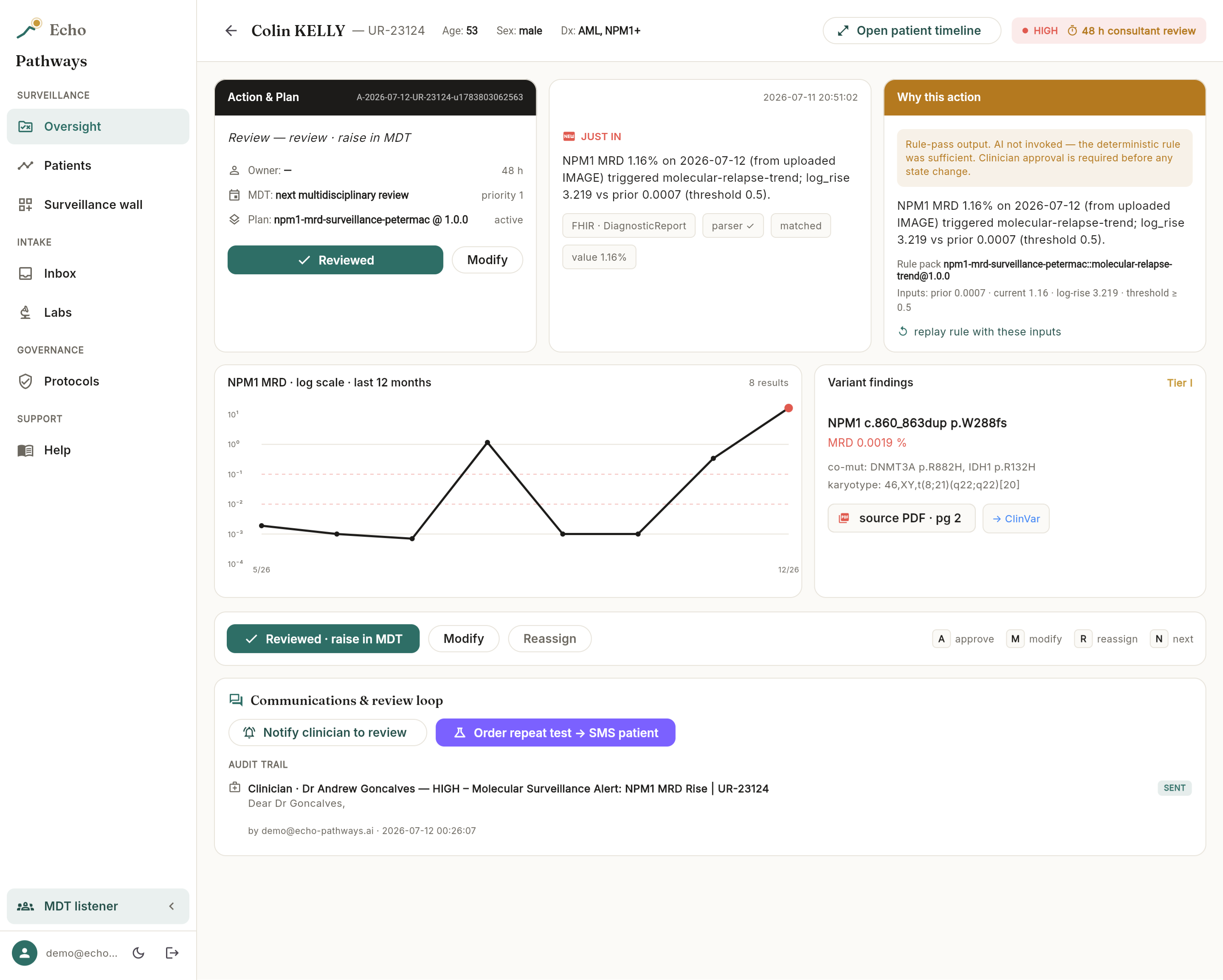
Every recommendation can be replayed.
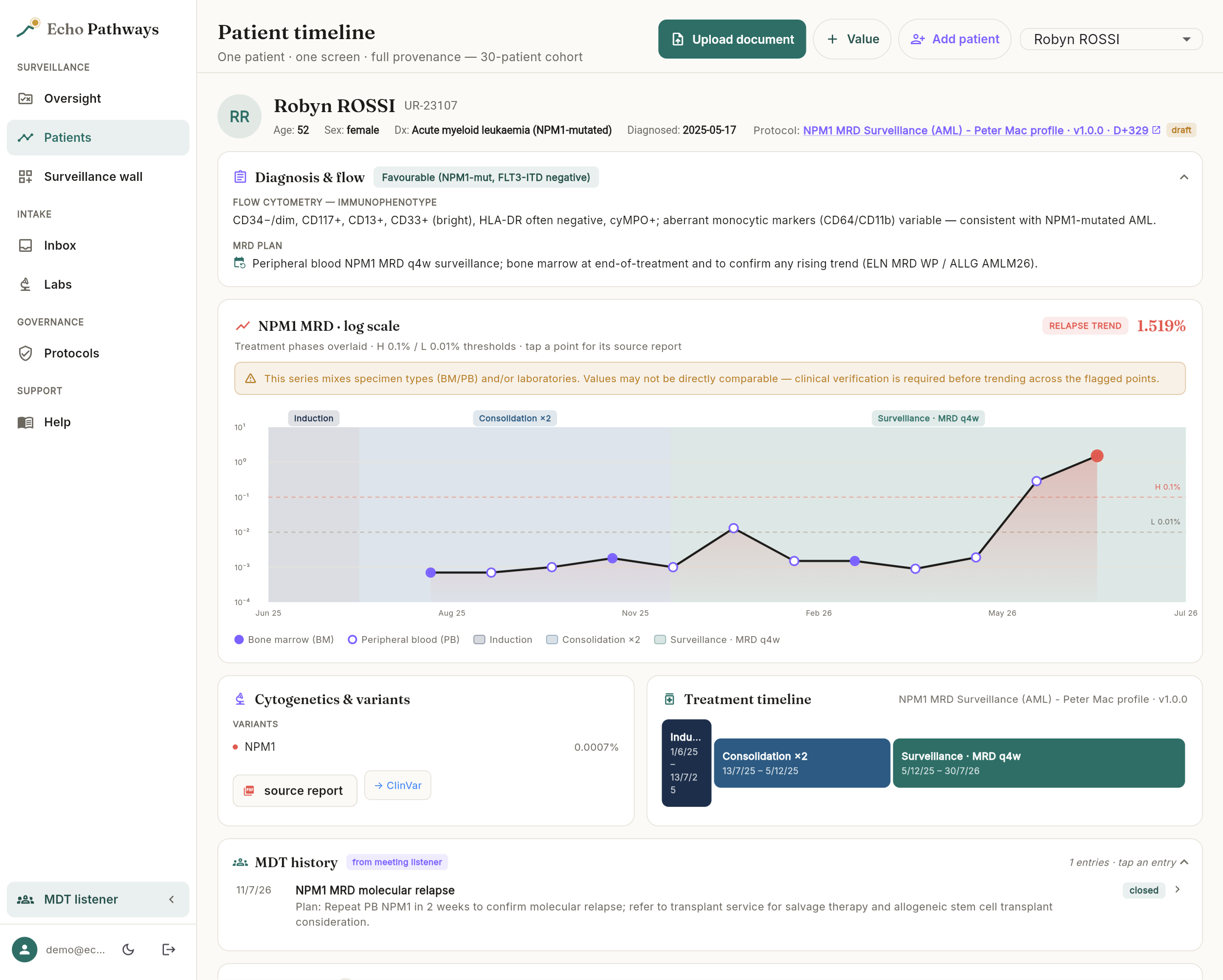
Open any action and you get the rule that fired, the exact inputs it was given, the source document it came from, and a hash of what we read. Re-fetch, re-hash, compare — the decision reconstructs. "Why did this fire?" has an answer, not an interpretation.
The role of AI
AI structures the pathology. Approved clinical rules determine whether action is required.
AI supports
- Reading facts from PDFs, images and free-text reports
- Extracting the value, and identifying test, marker, specimen and assay
- Reading reported units, scales and amendment status — without converting values
- Recognising uncertainty — low confidence goes to a human, never a guess
Approved clinical logic determines
- Unit and scale normalisation through deterministic rules
- Whether a protocol applies and a threshold is crossed
- Whether a test is overdue or a trend needs review
- Who is alerted, and by when
- Signed off by clinical leaders before it runs