
Protocols
Protocols are governed by clinicians. Echo Pathways makes them operational.
A protocol is content, not code. It declares what markers to watch, the deterministic logic to apply, the cadence of results it expects, the actions it may recommend, and who signed it off. The engine is the product; the clinical domain is data.
Governance lifecycle
A protocol goes live only after clinical sign-off.
01 · author
Authored or adopted
Written by your clinical governance team, or adopted from a standard guideline and adapted locally.
02 · test
Tested against history
Replayed over a retrospective cohort so its behaviour is measured before it is trusted — what it catches, and what it would have missed.
03 · sign off
Clinically signed off
A named clinical owner signs it off. Until then it is a draft and cannot fire.
04 · version
Versioned & retirable
A change to the logic bumps the version and requires re-sign-off. Protocols can be retired or replaced, and past decisions still replay against the version that made them.
A draft protocol cannot fire.
This is enforced by the engine, not by process discipline. If the logic changes, the version bumps and the sign-off is invalidated — there is no path by which unreviewed logic reaches a patient.
In the product
Detection rules, thresholds, and the sign-off history behind them.
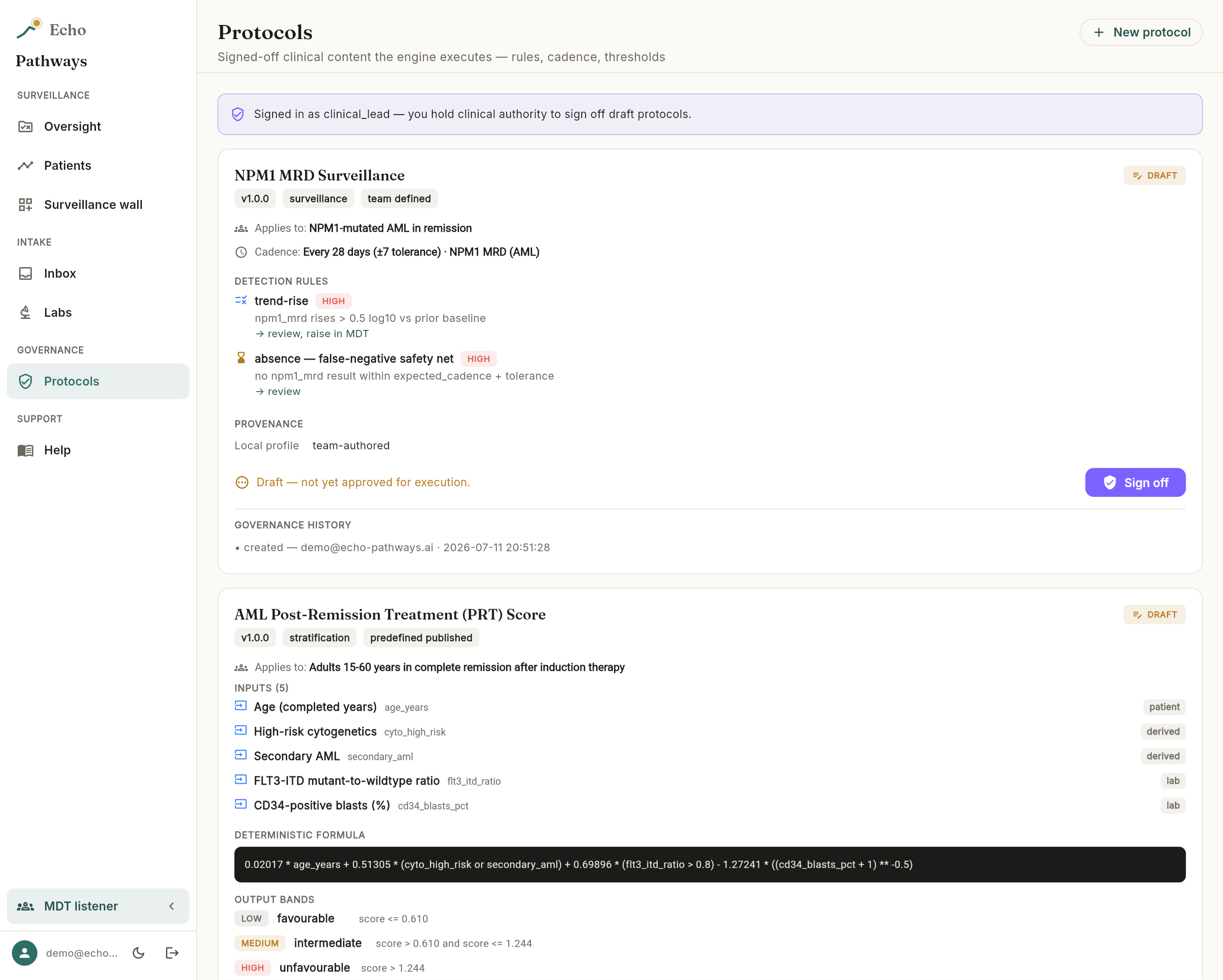
What a protocol declares
Everything the engine needs, and nothing it should infer.
Markers & logic
Which markers to watch, on which scale, and the deterministic rules that detect a trend or a threshold crossing.
Expected cadence
How often a result should arrive — which is what makes an absent result detectable rather than invisible.
Bounded actions
The vocabulary of recommendations it may raise, and who is responsible for each. The engine cannot invent an action outside this list.
Severity
How urgent each event is, and what escalates. High-severity always requires a human to authorise.
Governance
Version, clinical owner, sign-off record, and the citation trail behind each threshold.
Provenance requirements
What evidence must be attached to an action before a clinician is asked to act on it.