
Use cases
Any clinical pathway where a result determines whether action is required.
The engine is disease-agnostic. What changes between pathways is the protocol — the markers, the thresholds, the cadence, the actions. That is content, and content is authored, not engineered.
Initial use case — AML
The most demanding first validation environment.
Acute myeloid leukaemia brings serial molecular monitoring across multiple assays, laboratories, units and reporting conventions — exactly where clinical latency does the most harm. A rising NPM1 MRD is a signal that a relapse is beginning, and it can sit unread in an inbox looking like everything else.
We started here deliberately. If the platform holds in AML, it extends. If we had started somewhere easy, we would have proved nothing.
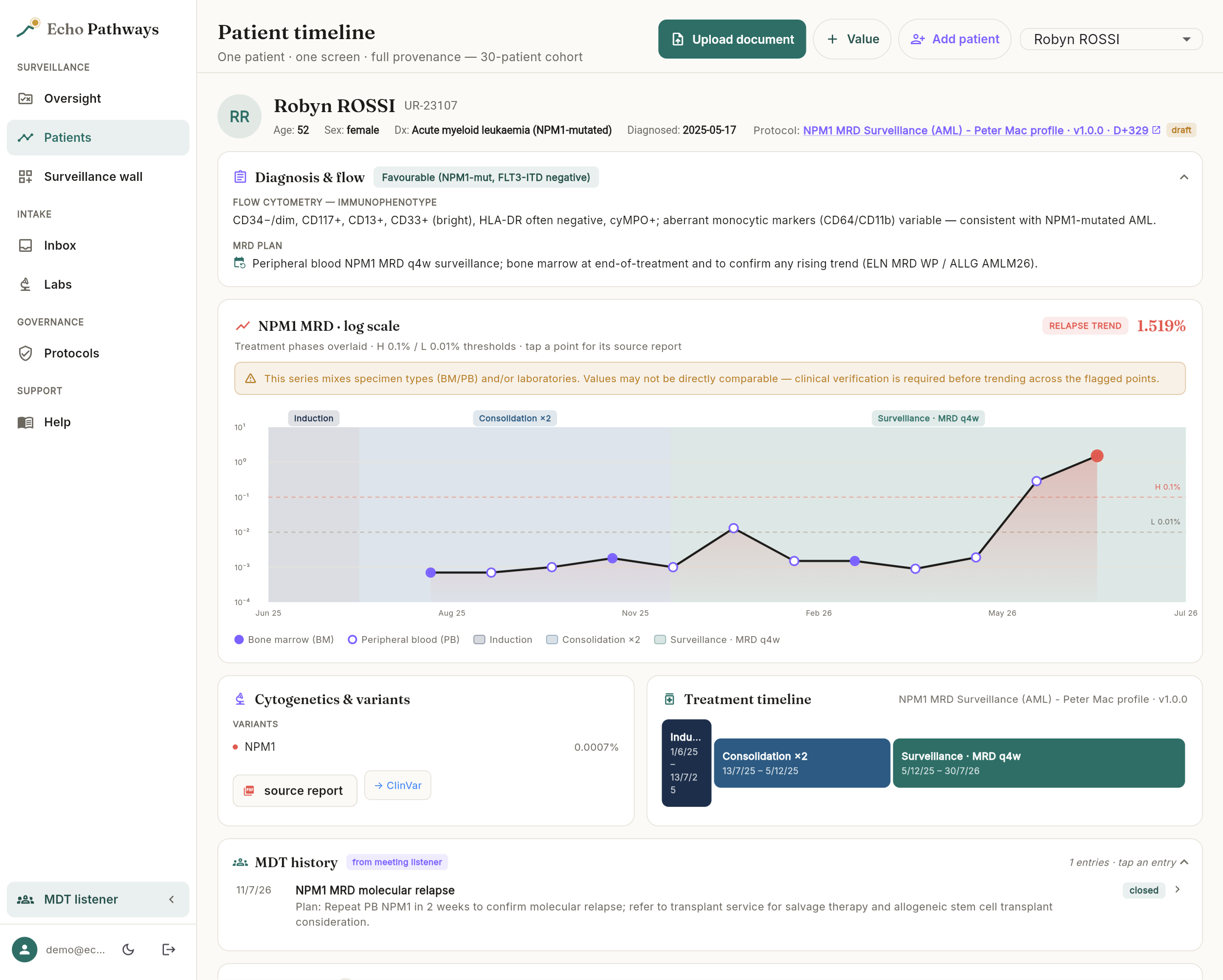
Serial molecular monitoring
Trend detection on a log scale, across assays that don't report the same way.
Specimen comparability
Is this result actually comparable to the last one — same assay, same specimen, same scale?
Missing-result detection
The repeat that was due 12 weeks ago and never came.
Expansion
Where it goes next.
AML — the flagship
The complex, high-value first use case: serial molecular surveillance, proven end to end, in the environment that punishes delay hardest.
Other blood cancers
CML, ALL, MDS, myeloma, lymphoma, post-transplant surveillance and molecular relapse monitoring — the same shape of problem, different markers.
Standard pathology-driven care
Neutropenia, chemotherapy toxicity, renal and liver monitoring, repeat bloods and overdue follow-up. Higher volume, lower complexity, same engine.
The test for a new pathway is simple.
Does a result determine whether an action is required? Can that judgement be written as a rule a clinician will sign their name to? If yes, it's a protocol. If the judgement can't be written down, it isn't ours to automate — and we won't pretend otherwise.
Have a pathway where results go unactioned?
That's the conversation we want to have.